EDSN Messaging
Normal operation
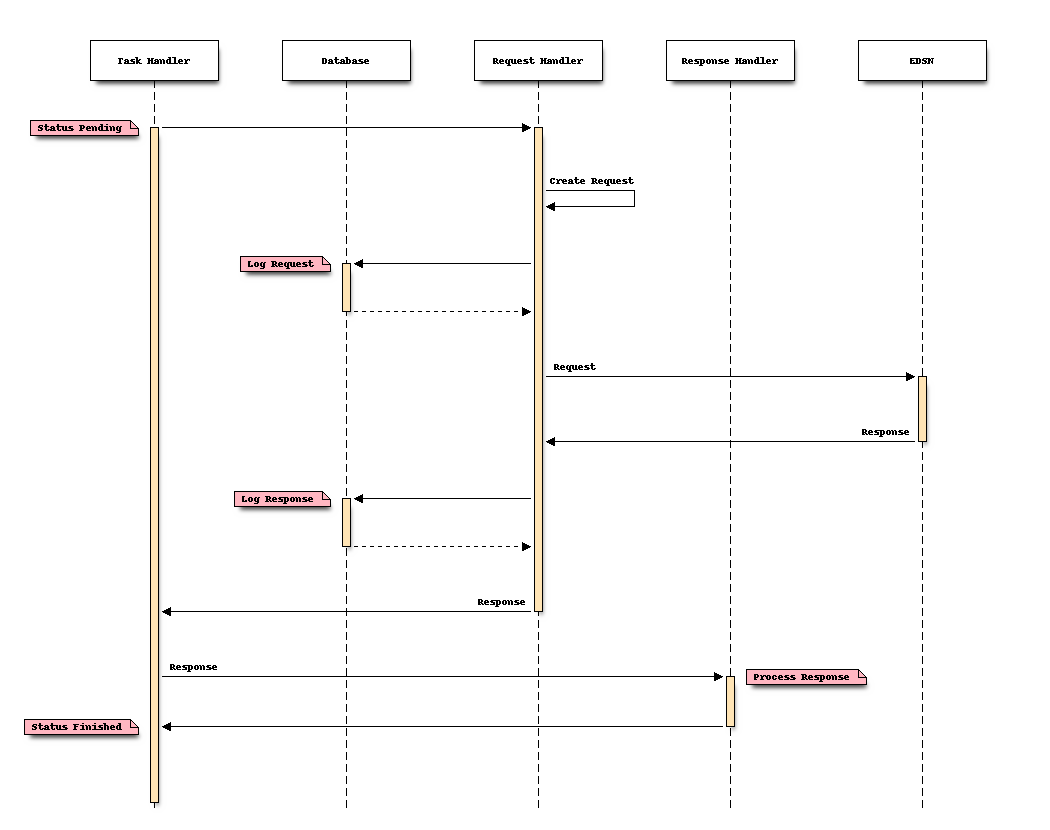
Message handling in case no connection failure, time-out or SOAP Fault occurred.
Connection failure
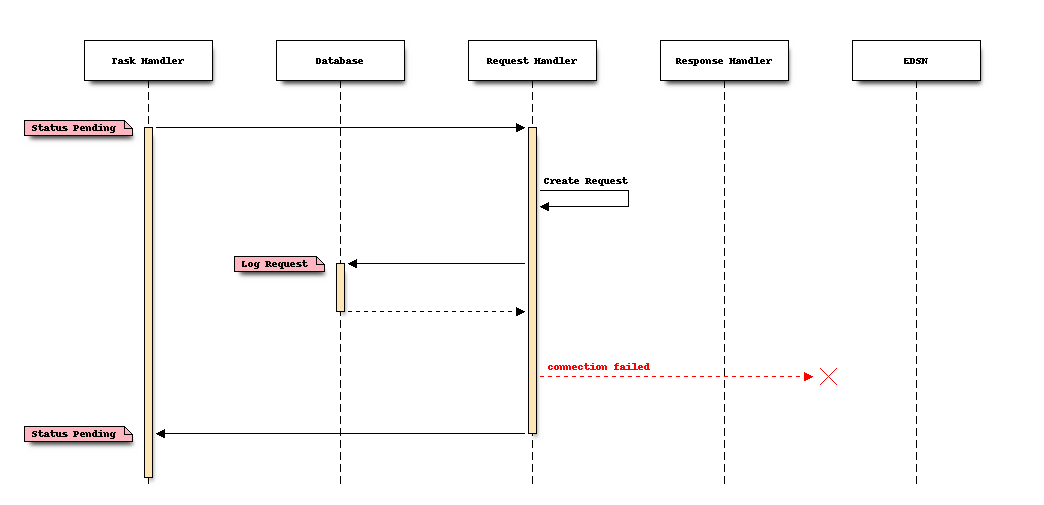
Message handling in case of a connection error.
In case of a connection error the messages can be send again in the next run as it is a normal operation so the state of the task stays Pending.
Time-out
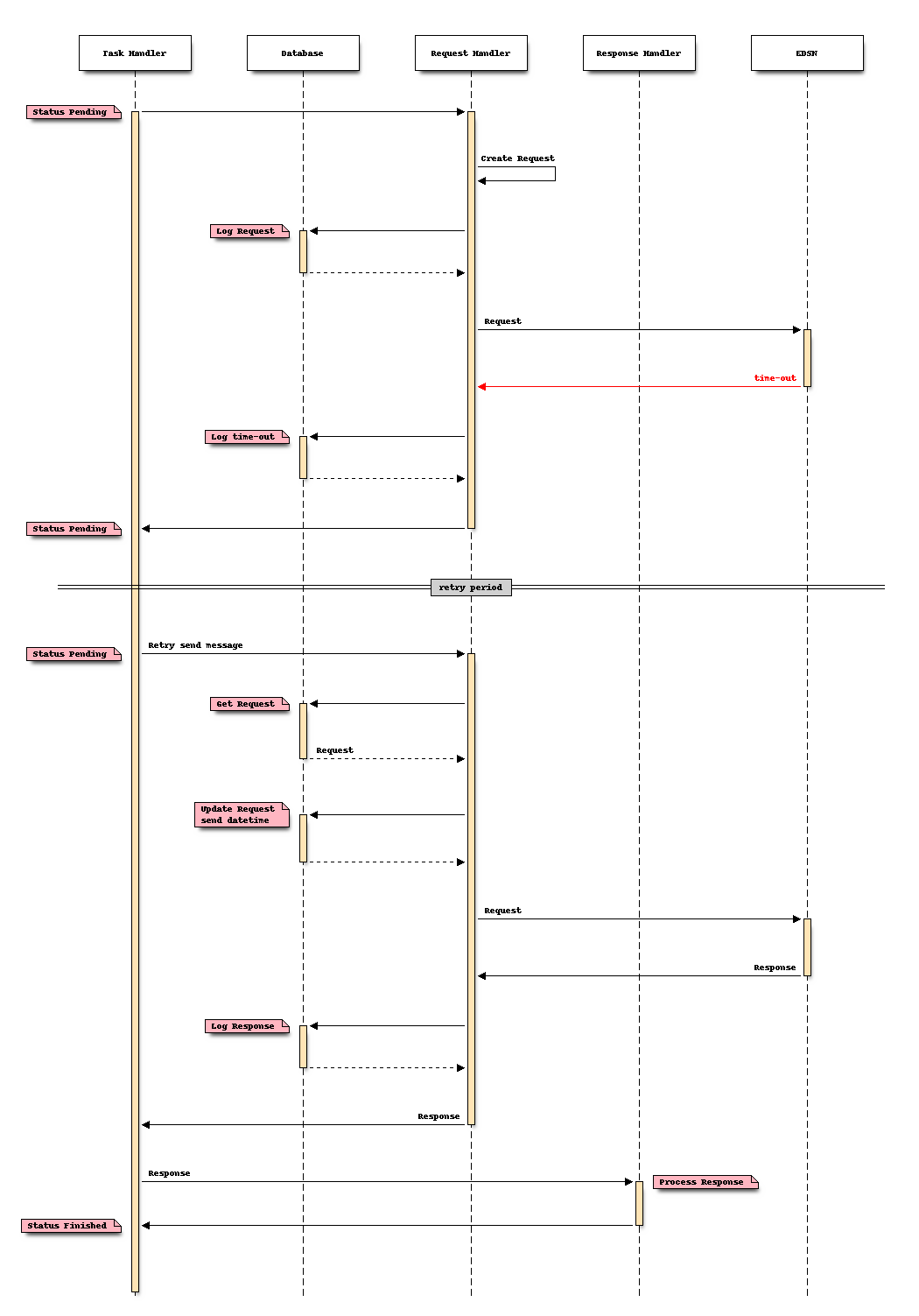
Message handling in case of a time-out. Time-out setting has a default setting for all services but can be set for a individual service as well.
Because the EDSN message handler is idempotent and the request could be processed by EDSN we need to send the request again with the same Message ID so EDSN will either send the available response or process the request and send the created response.
Note
TMR is not idempotent so handling for TMR messages is same as for connection failure.
SOAP Fault
Message handling in case a SOAP Fault is returned.
If a technical error occurs, a SOAP Fault will be returned. A SOAP Fault is one of the three message definitions with which a request/reply operation in a WSDL is described (in addition to input and output also a fault). The message definition of this generic SOAP Fault will contain an ErrorCode, an ErrorText and ErrorDetails. These three fields appear only once in the SOAP Fault.
The following technical errors are used:
Code |
Text |
ErrorDetails |
Remark |
Handling |
|---|---|---|---|---|
1 |
Database Error |
<None> |
A transaction could not be committed due to a database problem occurring |
Request is resubmitted with a new MessageID, handling same as connection failure |
2 |
XML Schema validation error |
<details of XML Schema validation error> |
The presented XML message does not validate against the associated XML Schema |
Task will be set in Error state. System administration must take appropriate action |
3 |
System error |
<None> |
The EDSN system is unable to process the message |
Request is resubmitted with a new MessageID, handling same as connection failure |
4 |
Security error |
<None> |
The Request will not be processed for security reasons |
Task will be set in Error state. System administration must take appropriate action |
5 |
Time-out |
<None> |
The Request will not be processed due to a timeout |
Request is resubmitted with a new MessageID, handling same as connection failure |
6 |
End of session |
<None> |
The Response to the Request could not be returned due to end of session of the EDSN service dispatcher |
Request is resubmitted with the same MessageID, handling same as time-out |
CorrelationID
The CorrelationID used in the EDSN Business Document Header is used to correlate different messages in a process. When received this CorrelationID must be used in the related process messages.
This is handled by the Request Handler and the corresponding Response Handler.